Priority Actions Summary
Concise, ranked recommendations focused on the highest-risk items first, timed where possible with existing capital work.
Roof Resilience Assessment
A focused roof review for owners, managers, and insurers who need clear information they can act on.
Field-based assessments of low-slope commercial and multi-residential roofs.
Design Vulnerabilities Under Extreme Rainfall
When primary paths are restricted, water has nowhere to go. The assessment identifies those vulnerabilities and documents them with clear visual evidence.
Reviewing the primary drains and the emergency overflow drains together is the first step in understanding whether a roof can handle the rainfall it now receives.
Core Offering
Each review is conducted on the roof itself, structured around the conditions that most often lead to preventable roof failures.
Primary drain layout and capacity across independent roof areas, plus the presence, location, and sizing of emergency overflow drains, the secondary path that protects the roof when the main drains are restricted.
Confirms whether each roof area can actually clear the rainfall it now receives, and where a second path out is missing.
Identification of blockage points, debris sources, and conditions that contribute to prolonged ponding and the bathtub effect, including roof areas served by a single drain.
Drainage capacity is only as good as the drain that is open, so cleaning and correction are targeted where flow is actually restricted.
On-site evaluation of roof access and the ability to inspect and maintain primary drains and emergency overflow drains under current conditions.
A roof that is difficult to reach is a roof that is rarely checked, and drainage problems build quietly between storms.
Supporting Deliverables
Prioritized findings for capital planning and risk decisions, written so owners, managers, and insurers can act on them directly.
Concise, ranked recommendations focused on the highest-risk items first, timed where possible with existing capital work.
Labeled plans of independent roof areas and drain locations, a shared reference for owners, managers, and contractors.
Documentation that supports discussions with boards, insurers, and technical consultants on foreseeable risk.
We identify issues and point to the right specialists (plumbers, roofers, or engineers) when further work is required.

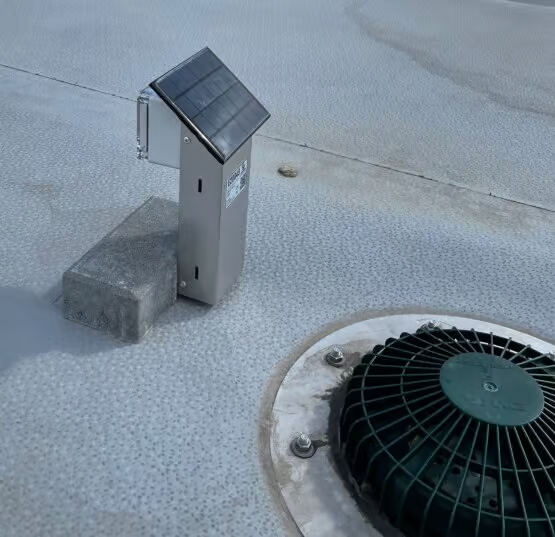
Where drainage vulnerabilities are observed during the assessment, ongoing visibility between visits can be an optional add-on to the package. As a local partner, GuardRoof can support installation and first-line support for the Sense DSW water level sensor on the Sense Smart Roofs platform.
The sensor sits at the drain and monitors standing water, providing an early alert when water levels begin to rise and drainage may be compromised.
Discuss a building, a portfolio, or a resilience assessment.